Development globally is perhaps faster than ever in world history with accelerating technological advancement having a major impact on daily lives. Skills required for the job market are evolving daily – with career pathways now looking very different, with positions such as an artificial intelligence engineer, a cloud architect, or mobile app developer becoming well paid careers. 85 per cent of the jobs that will exist in 2030 haven’t even thought about yet. With this rapid technological evolution today’s students are faces with very different choices and an ambiguity on being able to predict what the future holds, and the skills employers will need in the months and years to come.
As educators a broad education that focuses on the development of attitudes and skills alongside knowledge that can enable students to be adaptable, flexible and creative is now a greater priority than ever before in order to prepare students to be able to adjust to societal changes.
Cultural knowledge and learning skills which cultivate curiosity, problem solving, imagination, resilience and collaboration, emotional intelligence, technological literacy and objective judgment will enable students the ability to be agile and embrace change even in the face of adversity.
IB or A Level for future skills?
So what best meets the need for developing future skills – the IB Diploma or A Level?
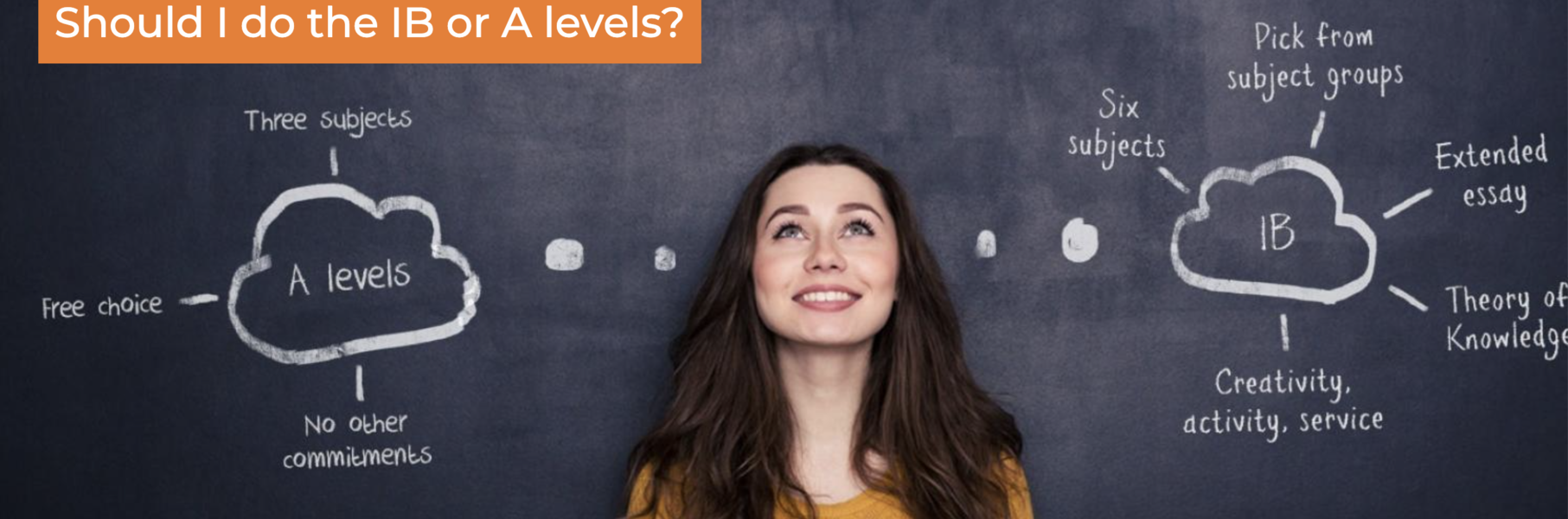
While A-Levels are ideal for those who know they want to specialise in a narrower range of subjects in greater depth the IB offers a broader learning experience across six subjects of English Language and Literature, maths, sciences, languages, humanities and the arts with a focus on nurturing an independent, and adaptable approach to learning.
A Levels and the IB are both widely recognised and respected by universities and employers around the world.
The IB is gaining more interest from the and employers because of its focus on preparing students with the skills and experience in line with an uncertain future.
The focus on problem solving
Independent thinking, using deep problem-solving skills to find a solution to increasingly complex problems is a skill which has become prevalent in the 21st Century due to the uncertainties, the pandemic, the technological developments.
The IB is aligned to developing skills that can be applied to many different situations.
Even during the pandemic, teaching the IB online has developed project-based skills such as collaborating with peers from other countries, debating, discussing, listening, delegating and respecting others’ views reflecting the needs of the world of work.
This connection with others from around the world opens students’ minds to diversity, different cultures, and the appreciation of others’ areas of excellence.
One of the IB’s greatest appeals, particularly in these uncertain times, is its international outlook. All students must take a foreign language – and IB ensures that a global mindset is woven through other IB subjects, from learning about international trade to understanding global religions.
Remote learning
The recent pandemic storm has improved global education. It has enabled teachers and students to use platforms such Zoom or Google classroom, immersive virtual reality (VR) teaching, and working and experiencing virtual environments, giving students unlimited experiences to immerse themselves in tomorrow’s learning.
The IB Diploma and university entrance
Student and parents are increasingly taking notice of the IB because of its acceptability with 95% of admissions agreeing that the IB prepares students well for university through the evidence from IB students who are attending universities. Statistically it is the fastest growing qualification in the world, taught in 97 countries and welcomed by the best academic institutions.
Agile students with a broader mindset and skills that give them a level of adaptability to take on the constant evolution of our world are more likely to thrive.
Advising our students
Would A levels or the IB be better in terms of subject choices?
With A levels, students are free to pick any combination of subjects they like (as long as their school or college can timetable it). So, for example, if they want to take all humanities subjects they can.
However, the curriculum will be fairly narrow, as it’s normal to take just three subjects.
The IB is designed to ensure students study a broad range of subjects (six in total). However, they can’t choose any combination you like. Subjects are divided into six groups (eg sciences, modern languages and humanities) and you take one from each of the first five groups; the sixth subject can be either from the sixth group, which is arts, or a second subject from any of the other groups.
So this won’t suit students if there’s one particular subject group they want to focus on (or avoid!) but could be good if they enjoy a bit of everything.
Would doing the IB keep more degree subject options open to them?
Despite studying six subjects on the IB, students only take three (or occasionally four) at higher level and the other three (or two) at standard level.
For university courses that require specific subjects at A level or equivalent, IB students typically need to take these subjects at higher level rather than standard level.
So whether they take the IB or A levels, they’ll typically only have three subjects that will help them meet specific entry requirements.
So are there any benefits to studying six subjects on the IB?
There are other benefits to studying six subjects rather three, such as:
- Getting a broader education
- Keeping up useful subjects (such as maths and foreign languages), even if they don’t directly relate to their future plans
- Studying subjects students enjoy, even if they don’t directly relate to their future plans
- Trying out subjects they might want to study at university. Whereas some degree courses require students to have studied a particular subject at A level or IB higher level, many others are more flexible and either don’t ask for any specific subjects or have quite broad subject requirements (eg ‘a maths or science subject at A level/IB higher level’). So for example a student could study a subject such as psychology at standard level and still take a degree in it if they want.
Is the IB more work than A levels?
Broadly speaking the IB will take up more of student time than A levels.
There will be more teaching time and fewer study periods as well as additional work on theory of knowledge assignments, an extended essay and ‘creativity, action, service’ commitments.
With A levels
There is more flexibility on how students you use their time, as there’s more focus on independent study.
There are likely to be more study periods during the school day.
There are have fewer subjects. There is no commitment to doing anything else apart from study for your subjects.
Best fit globally?
The A-Level program is not internationally recognized in the same way as the IB.
It also requires a student to have a strong sense early on of their preferred career or course of university study.
A-Level students will not experience the same breadth of topics as on the IB, and they will be required to specialize or narrow down their areas of interest far sooner.
Final comments
In terms of providing students with agility, a broader mindset and the skills that give them a level of adaptability IB is a good choice. A-levels still provide students who have a clear career pathway to achieve their goals. The diversity of pathways provides our young learners an exciting future.