The international schools market in 2025 is vibrant, diverse, and rapidly evolving. Growth is being driven by both local and expatriate demand for high-quality, globally recognised education.
The rise of hybrid curricula, school groups, and holistic education reflects a sector that is not only expanding but also innovating to meet the needs of a changing world.
Teacher retention and professional development remain key challenges, but the overall outlook for international education is bright and full of opportunity – with 84% of teachers planning to leave their current roles citing career development as the main reason.
Mapping the Global Growth of International Schools:
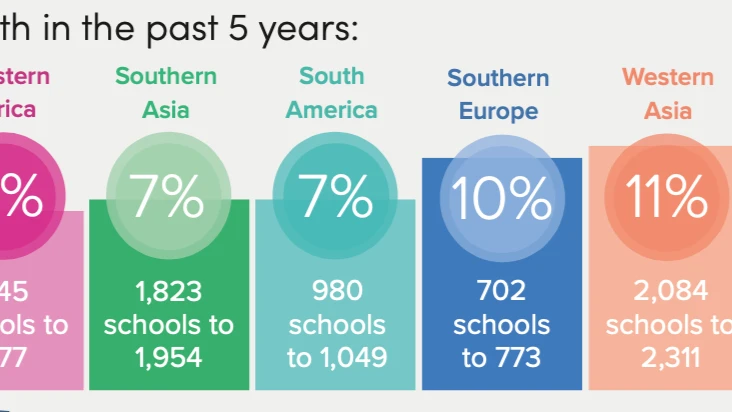
The international schools market has experienced remarkable growth and transformation over the last five years. The Visual White Paper Data 2025 provides a comprehensive look at the trends, challenges, and opportunities shaping this dynamic sector. Here’s a clear summary of the main findings and what they mean for the future of international education.
Strong Global Expansion
Between January 2020 and January 2025, the international schools sector saw significant expansion:
- School Numbers: Grew by 8% to a total of 14,833 schools worldwide.
- Student Enrolment: Increased by 13%, now reaching 7.4 million students.
- Staff Recruitment: Rose by 14% to 713,539 staff members.
- Total Fee Income: Jumped by 22% to $67.3 billion.
Regional and Country Highlights
- South-Eastern Asia and Western Asia are key growth areas, with 53 and 57 new schools planned, respectively.
- Major Markets: Pakistan (703 schools), Brazil (438), China (1,124), India (972), and the UAE (836) are among the largest markets.
- Spain, Brazil, and Vietnam have shown particularly strong growth, with Brazil’s sector expanding by 32% in school numbers and Vietnam seeing a 24% increase.
Curricula and School Groups
- Top Curricula: International Baccalaureate 37 %,- Cambridge 35% – UK 28 % – US 20% and AP – 9% programs are the most popular.
- Hybrid Education: 78% of international schools now offer more than one curriculum, reflecting a move towards blended, globally integrated education.
- School Groups: 38% of international schools are part of a school group, and 59% of planned new schools will join these networks, highlighting the growing influence of branded educational groups.
Market and Operational Trends
- Professional Development: Teacher retention is a challenge, with 84% of teachers planning to leave their current roles citing career development as the main reason.
- Asia, especially Eastern and South-Eastern Asia, is a top destination for teachers seeking growth.
- Student Demographics: The student body is becoming more diverse, with a larger proportion of local and multilingual students.
- Holistic Education: Schools are investing in extra-curricular activities, soft skills, and innovation—15% now have robotics labs.
- Western Independent Brands: Prestigious Western schools like Wellington College and Harrow are expanding internationally, with 72 new branded schools planned.
Emerging Trends
- Inclusive and Integrated Education: Schools are blending local and international curricula to better serve diverse student needs.
- Focus on Wellbeing: There is a greater emphasis on student wellbeing, special educational needs (SEN), and holistic development.
- Data and Intelligence: The sector is increasingly reliant on live data portals and market intelligence to guide investment and strategic decisions.
For more detailed insights, visit ISC Research or explore the full Visual White Paper Data 2025.