
Curriculum frameworks are not the secret.
They give us structure – wherever they come from. British, American, IB, Finnish…
They provide progression, coherence and accountability. But structure alone does not guarantee high‑quality teaching and learning.
That comes from the professional judgement of teachers – their ability to adapt, to notice, and to respond in the moment.
When teachers are trusted with agency, they don’t dilute rigour. They deepen it.
They ensure that students leave not only with secure knowledge, but with the skills to apply it, question it, and extend it – across subjects, contexts and cultures.
What We Mean by High‑Quality Teaching and Learning
High‑quality teaching and learning is about human interaction – not AI.
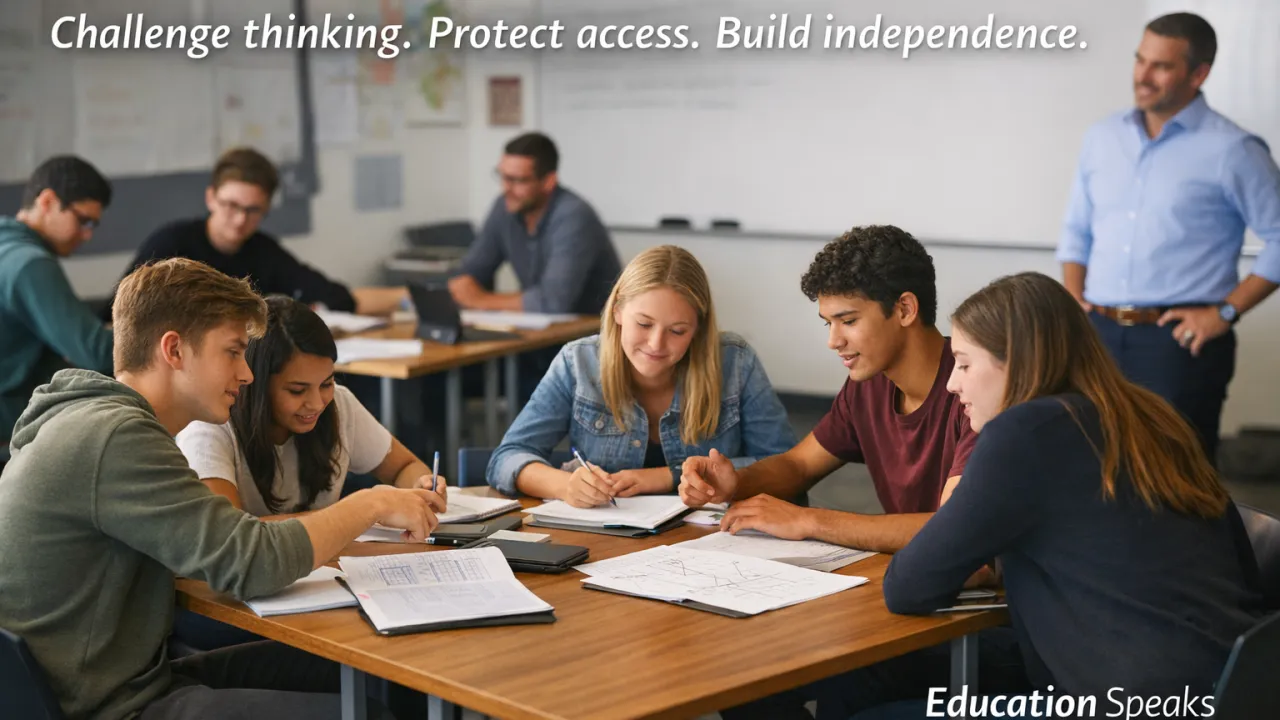
It is a lived reality in classrooms where:
• Knowledge is taught with clarity and depth, often through conceptual lenses that help students transfer understanding.
•Skills -critical thinking, collaboration, communication, resilience-are deliberately cultivated and revisited across disciplines.
• Assessment is varied enough to capture both product and process, with feedback that guides reflection and growth.
• Professional judgement is exercised daily, not as an exception but as the norm.
It is the teacher who reframes a question so a hesitant student finds their voice.
It is the colleague who adapts an activity mid‑lesson because the class needs a different route to understanding.
These are not deviations from rigour-they are its expression.
Inspire to Learn: Knowledge and Skills in Partnership
When students are invited into the process, quality rises.
In a Year 9 history unit, students shaped inquiry questions on migration. The framework remained intact, but the ownership shifted.
Engagement soars, and so does the quality of work.
What matters most is not just the knowledge they gain, but the skills they practise: research, questioning, analysis, and reflection.
High‑quality learning is not about choosing between knowledge and skills.
It is about weaving them together so that one strengthens the other and so that students begin to see learning as a connected, purposeful journey.
Learn to Innovate: Iteration as a Skill
Innovation is the engine of skill development. A teacher trialling a new approach, gathering feedback, and refining it for the next lesson is modelling adaptability and resilience.
Students see that learning is iterative, that mistakes are part of progress and that reflection is not a final step, but a habit.
High‑quality teaching is iterative, reflective, and responsive.
It is not about novelty for its own sake, but about sharpening practice until it works for every learner.
And in the process, students learn how to think critically, how to adapt, and how to persist -skills that extend far beyond the classroom and into life.
Lead to Empower: Creating the Conditions for Quality
Leadership that empowers teachers creates the conditions for high‑quality teaching and learning.
When schools invite teachers to propose new units, share adaptations, and see their ideas acted upon, the result is not chaos but coherence.
Teachers feel ownership, and students experience the difference in the richness of their learning.
In those classrooms, students don’t just acquire knowledge -they practise the skills of inquiry, collaboration and reflection that will carry them beyond school.
They begin to see themselves not just as learners, but as thinkers, contributors and change-makers.
Restoring Rigour
There is a misconception that agency risks lowering standards.
In truth, it restores them.
Rigour is not found in rigid scripts, but in the disciplined application of professional judgement.
High‑quality teaching and learning emerges when structure and flexibility are held in balance-when teachers are free to notice, to adapt, and to lead learning forward.
And when they do, students leave not only with strong academic outcomes, but with the skills to apply them in unfamiliar contexts, to solve problems, and to lead change.
A Quiet Invitation
Perhaps the next step is not a wholesale redesign, but a single question at your next team meeting?
Where could we adapt this unit to raise both the quality of learning and the skills our students take away?
Agency is not about abandoning structure. It is about reclaiming judgement.
And in doing so, we remind ourselves and our students that high-quality teaching and learning is not a checklist, but a lived practice.
Knowledge and skills, woven together, are its true measure.
#HighQualityTeaching #SkillsForLife #TeacherAgency #CurriculumDesign #ProfessionalJudgement #QuietConfidence