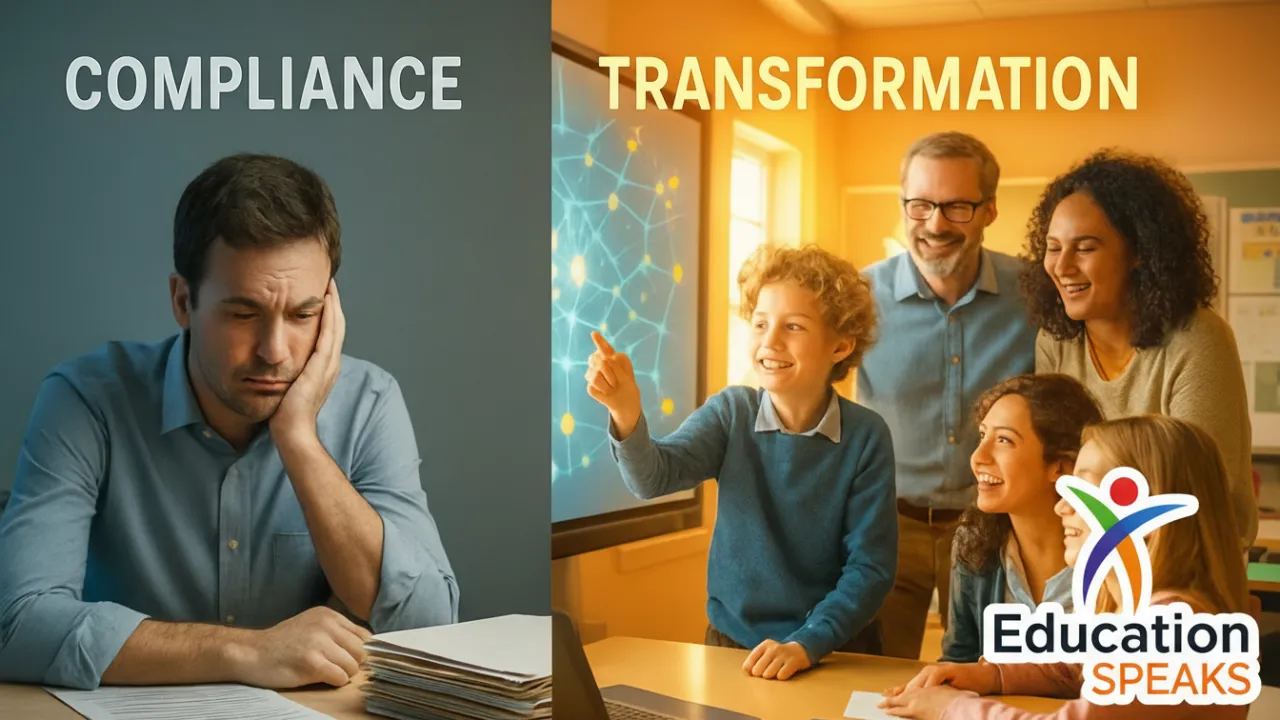
The debate is over: international accreditation is not a destination; it is a launchpad. Yet, for too many schools, the rigorous process of achieving CIS International Accreditation becomes a compliance exercise – a ceiling of achievement rather than a floor for continuous, radical development. They meet the standards, tick the boxes, and receive the coveted seal, but they fail the spirit of the process. They are accredited, but not truly developed.
The true test of a school’s commitment to transformation lies in its response to the core criteria for Leadership and Professional Development. This domain of the accreditation framework is not a bureaucratic afterthought; it is the engine room of the school, the crucible where vision is forged into reality.
The Hidden Crisis in Compliance: Leadership and Staff Development
The CIS framework is brilliantly structured, moving beyond simple metrics to ask essential questions that demand deep, reflective answers. Consider the core standards for leadership and staff development:
Leadership: The school must demonstrate effective leadership that aligns with its mission and ensures strategic planning.
Culture: Leadership must foster a culture of collaboration, inclusion, and well-being.
The Core Standard: The school must provide for the continuous professional development of faculty and staff that relates to school priorities and, crucially, contributes to student learning.
It is in the execution of the standard for continuous professional development that the hidden crisis emerges.
Most professional development (PD) is episodic, generic, and mandated from the top down. It is a one-off event, a conference, or a half-day workshop.
This model is the antithesis of the requirement for continuous PD. It fails to meet the essential question:
In what ways does professional development contribute to student learning and staff growth? The evidence is often anecdotal, the impact fleeting.
This is where the debate must shift. We must stop asking, “Are we compliant?” and start asking, “Are we truly transformative?”
“Education Speaks”: The Transformation-First Voice
“Education Speaks” is not merely a platform; it is the systemic answer to the essential questions of the framework. It reframes the entire concept of professional development from a logistical burden to a cultural imperative, making the continuous, evidence-based growth required by international standards not just possible, but inevitable.
By integrating a transformation-first voice, “Education Speaks” directly addresses the most challenging aspects of leadership and staff development:
Core Development Criteria – The Challenge in Traditional Schooling
The “Education Speaks” Solution
Continuous Professional Development – is episodic, generic, and lacks measurable impact on student learning.
Provides personalised, on-demand, and evidence-based learning pathways, ensuring PD is truly continuous and directly linked to school priorities.
Culture & Well-being Collaboration is siloed; staff feel disconnected from strategic vision and their own growth.
Fosters a culture of shared inquiry and open dialogue, building the collaboration, inclusion, and well-being required by leadership.
Essential Question: Sustainability
Knowledge resides in key individuals; leadership structures are vulnerable to staff turnover.
Creates a sustainable, internal knowledge base and a self-improving ecosystem, ensuring that leadership capacity (F5) is resilient and future-focused.
Essential Question: Future-Focus
Strategic planning is reactive, not proactive; staff are unprepared for emerging educational trends. Empowers staff to be proactive learners and innovators, providing the data and resources needed to ensure leadership is responsive to change.
The core of the “Education Speaks” value proposition is its ability to operationalise the standard for continuous professional development.
This moves PD from a passive consumption model to an active, contributory one.
When staff are empowered to share, curate, and engage with learning that is immediately relevant to their classroom and the school’s strategic goals, the answer to the framework’s question
How effectively does leadership articulate and embed the school’s vision and values? becomes self-evident in the daily practice of every educator.
The Consequence of True Development
Schools have a choice. They can choose to simply comply with the framework’s requirements, treating the accreditation process as a necessary evil to maintain status. Or, they can embrace the consequence of true development, using the framework as a blueprint for building a genuinely self-improving, resilient, and future-ready institution.
“Education Speaks” is the mechanism for the latter. It is the tool that ensures the school is not just ready for the next accreditation visit, but that it is already living the answers to the essential questions every single day. The debate is not about whether a school should develop, but how. And the only way to achieve the continuous, transformative development demanded by the core standards is through a systemic, culture-shifting approach.
Accreditation is the map; “Education Speaks” is the compass that guides the school to its true north, ensuring that every standard met is a step toward genuine, lasting educational excellence. The time for mere compliance is over. The time for transformation is now.